Warren Bell, Author

Tuesday, October 20, 2015

Venturing Into a Different Genre


http://amzn.to/1PEhP22
This past weekend, I published something very different from my other works. With Halloween approaching, I decided to write and publish a horror story. That may sound about as far from my usual military historical fiction as one can get. But perhaps not.

Why would I choose to write horror? I have been fascinated by the genre since I was a child. My mother loved horror films, and our whole family went to the movies together. Like Cosby’s Fat Albert and his buddies, I used to crouch behind the seats and peer between them to watch the scary scenes. I remember watching Lon Chaney Jr.’s face change from that of a man to that of a wolf through time-lapse photography. I recall the mummy’s ghost carrying Ramsay Ames into the swamp until they disappeared.  I saw David Carradine, in my opinion the best Dracula, turn to dust when caught by the sunlight. We also saw all the horror anthologies like Frankenstein Meets the Wolfman and Abbot and Costello Meet Frankenstein. A latecomer to the scene was The Creature From the Black Lagoon.

About the time I became a teenager, an amazing comic book series (actually short graphic novels) called Tales from the Crypt appeared on the market. The werewolves, vampires, and other monsters in these books were convincingly drawn, and the stories were spine tingling. Unfortunately (for fans of the series) someone convinced the publisher that he was contributing to juvenile delinquency, so he pulled the plug on the books. Some years later, the title was revived on a TV series.

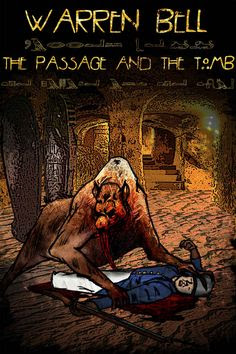
My new story, The Passage and the Tomb: A Tale of Ancient Horror, takes place in Egypt in the early 1800s. My characters are soldiers and scientists from Napoleon’s invading army. Okay, so I can’t really suppress the historical novelist in me. Napoleon’s savants studied and documented the ancient Egyptian civilization for several years. They essentially invented Egyptology. What better foils to confront an ancient evil than the explorers who opened up the longest lasting civilization to the world?

Inadvertently, my characters free a 4,000-year-old werewolf who had been entombed alive by the ancients.  Will modern firearms protect them? Or is the power of the timeless monster too great to overcome? Read my story to find out.


Warren Bell is an author of historical fiction.  He spent 29 years as a US Naval Officer, and has traveled to most of the places in the world that he writes about.  A long-time World War II-buff, his first two novels, Fall Eagle One and Hold Back the Sun are set during World War II.  His third novel, Asphalt and Blood, follows the US Navy Seabees in Vietnam.  His most recent novel, Snowflakes in July, was released on Kindle on September 15, 2015, and a paperback version will be following.  For more about Warren Bell, visit his website at: wbellauthor.com or see him on twitter @wbellauthor.  

Saturday, October 3, 2015

Why I Write Novels About History


I have been interested in history for as long as I can remember. I started to school in 1942 during the bleakest days of the Second World War. Even in first grade, we knew that we were living in momentous times. Our chief entertainment outside the home in those days was the motion pictures we saw almost every weekend. Dramatic newsreels written to support the war effort screened between feature showings. We were routinely introduced to parts of the world that our parents hardly dreamed of in their childhoods.

The history we were taught in school was too often the dry memorization of dates and event names, but there were also other, more personal sources of historical data. At that time, many Civil War veterans were still alive, and some of the old soldiers loved to spin tales off that conflict. World War I veterans were quite common. All our grandparents had heard personal oral histories from their ancestors. Many of these stories were passed down from generation to generation.

I have always viewed history as the summation of the accomplishments of people. In the 1950s, many historians viewed their discipline through the prism of movements shaped by events. The personal influence of individual leaders was minimized. Events shaped the leaders, not vice versa. I never subscribed to this view. I grew up in an age of leadership giants. The personal accomplishments of men like Franklin Roosevelt and Winston Churchill just didn’t fit into the view of events shaped history. Leadership giants still emerge in the world. Can anyone imagine modern South Africa in its present form without Nelson Mandela? I certainly can’t.

One thing our teachers did emphasize was George Santayana’s statement in his 1905 The Life of Reason that: “Those who cannot remember the past are condemned to repeat it.” The mistakes made by the Western Democracies during the 1930s that allowed Adolf Hitler to achieve supremacy in Europe were hammered into our brains.

I sometimes question whether history is taught at all in schools today. I know that my children did not receive a good grounding in the subject. If new generations do not understand what ideas have worked or not worked in the past, are they not likely to keep making the same mistakes over and over again?

A good case in point is to compare the workup to the 2003 invasion of Iraq with the early years of U.S. involvement in Vietnam. In both cases, civilian appointees in the Department of Defense believed that they understood the situations better than uniformed military officers. In both cases, an attempt was made to apply just enough military force to cause the enemy to capitulate. Civilians pared the order of battle for the Iraq invasion of elements considered critical by on-scene commanders. In neither case did civilian or military commanders have an understanding of the local cultural elements that would later play such vital roles. All the valuable experience in counterinsurgency that we gained in Vietnam seemed to have been largely forgotten. CI warfare had to be relearned and again paid for in blood.

In the last part of the Twentieth Century, collectivist governments failed all over the world. Communism and socialism proved to be unsustainable systems of governing. Many people in the United States do not seem to be aware of these facts. Some political candidates are again touting socialist principles.

My latest novel, Snowflakesin July, is set in the turbulent 1960s and 1970s when the New Left movement spawned a host of domestic Marxist terrorists.  But the Vietnamese Marxist state that came out of the war became one of history’s greatest failures. Capitalism now flourishes throughout Southeast Asia.

Take heed of history. Let’s stop making the same stupid mistakes over and over again. 


Warren Bell is an author of historical fiction.  He spent 29 years as a US Naval Officer, and has traveled to most of the places in the world that he writes about.  A long-time World War II-buff, his first two novels, Fall Eagle One and Hold Back the Sun are set during World War II.  His third novel, Asphalt and Blood, follows the US Navy Seabees in Vietnam.  His most recent novel, Snowflakes in July, was released on Kindle on September 15, 2015, and a paperback version will be following.  For more about Warren Bell, visit his website at: wbellauthor.com or see him on twitter @wbellauthor.  


Monday, September 21, 2015

Why I Set Snowflakes in July in the 1970s

Pentagon room blown up by Weather Underground

My new military thriller, Snowflakes in July, takes place during the 1970s. Not many novels seem to be written about this period. I believe that those of us in the United States have wiped these turbulent times from our collective memory. I also believe that the human brain tends to suppress bad memories and reinforce pleasant ones. But I agree with George Santayana’s statement in his 1905 The Life of Reason that: “Those who cannot remember the past are condemned to repeat it.”

Momentous events occurred in the 1970s. Perhaps the Watergate Scandal that forced Richard Nixon from office was the most significant. The fall of Saigon negated all the American military efforts in the previous decade to preserve South Vietnam as an independent country. At least our POWs were released and returned home after years of confinement and torture in the infamous “Hanoi Hilton.” And then there was the domestic terrorism that plagued our society.

As I wrote in a previous blog, “The highest incidents of terrorist attacks in the U.S. occurred during the 1970s. In a six-month period in 1971 and 1972, over 2,500 bombings took place in the U.S. The following chart from the Washington Post illustrates this point.


Why were the Seventies so violent? The turbulent Sixties spawned a number of groups seeking to impose their ideologies of the rest of the country through force and terror. The Ku Klux Klan, perhaps the largest and most long-lived terrorist group in U.S. history, was still attacking and sometimes murdering civil rights leaders. Some radical black power organizations declared war on the police. They began bombing police stations and shooting policemen and moderate African American leaders, whom they branded “Uncle Toms.” Puerto Rican nationalists, who had earlier tried to kill President Truman and had shot up the House of Representatives, carried out more bombings and shootings. They blew up the Mobil Oil headquarters and ambushed a U.S. Navy bus, killing some of the occupants. And then there were the terrorist groups spawned by the American New Left.

Perhaps best known of the New Left groups was the Charles Manson “family,” the murderers who massacred movie star Sharon Tate’s family and tried to kill President Ford. Also fairly well known was the Symbionese Liberation Army, principally because they kidnapped Patty Hurst and brainwashed her into helping them rob a bank. They also assassinated moderate African Americans. Less well known to the general public was the Weather Underground or Weathermen. The Weathermen espoused the violent overthrow of the U.S. government and replacing it with a Marxist society. Terror was their weapon of choice. One of their leaders admonished them to be “crazy MFs and scare the hell out of honky America.” The Weathermen exploded bombs in police stations and government buildings, including the State Department and the Senate Office building. Weathermen also conducted an infamous armored car robbery. Fortunately, the deaths of some of their bomb makers in an accidental explosion hindered their bombing campaign.”

The plot of Snowflakes in July tracks the founding and expansion of a New Left terrorist group called the Phoenix Guards Brigade (PGB). Like the Symbionese Liberation Army, their military commander is a former special forces expert. The PGB’s principal advantage over competing terrorist cells is a mole in the high levels of the Pentagon. Their mole fingers weaknesses in U.S. nuclear weapons compounds that may allow the theft of nuke bombs. The terrorists mobilize to mount a commando mission to steal nuclear weapons.

My novel’s protagonist, Captain Mike Duvall, is a U.S. Navy aviator who has just been released after years of confinement in the “Hanoi Hilton.” His experiences as a POW are woven throughout the story. Mike begins to suspect the conduct of the mole and starts an investigation. After he enlists a Navy lawyer, Leslie Thomas, in his efforts, he falls in love with her. The PGB learns of her queries and begins to blackmail her with photos of a youthful indiscretion. Will Mike uncover the plot to steal nukes before the terrorists can mount their raid? And what must Leslie endure at the hands of the PGB before the climax of the story?

Read Snowflakes in July to find out.


Warren Bell is an author of historical fiction.  He spent 29 years as a US Naval Officer, and has traveled to most of the places in the world that he writes about.  A long-time World War II-buff, his first two novels, Fall Eagle One and Hold Back the Sun are set during World War II.  His third novel, Asphalt and Blood, follows the US Navy Seabees in Vietnam.  His most recent novel, Snowflakes in July, was released on Kindle on September 15, 2015, and a paperback version will be following.  For more about Warren Bell, visit his website at: wbellauthor.com or see him on twitter @wbellauthor.  

Saturday, September 19, 2015

Why I Set Snowflakes in July in the 1970s

Pentagon room blown up by Weather Underground

My new military thriller, Snowflakes in July, takes place during the 1970s. Not many novels seem to be written about this period. I believe that those of us in the United States have wiped these turbulent times from our collective memory. I also believe that the human brain tends to suppress bad memories and reinforce pleasant ones. But I agree with George Santayana’s statement in his 1905 The Life of Reason that: “Those who cannot remember the past are condemned to repeat it.”

Momentous events occurred in the 1970s. Perhaps the Watergate Scandal that forced Richard Nixon from office was the most significant. The fall of Saigon negated all the American military efforts in the previous decade to preserve South Vietnam as an independent country. At least our POWs were released and returned home after years of confinement and torture in the infamous “Hanoi Hilton.” And then there was the domestic terrorism that plagued our society.

As I wrote in a previous blog, “The highest incidents of terrorist attacks in the U.S. occurred during the 1970s. In a six-month period in 1971 and 1972, over 2,500 bombings took place in the U.S. The following chart from the Washington Post illustrates this point.


Why were the Seventies so violent? The turbulent Sixties spawned a number of groups seeking to impose their ideologies of the rest of the country through force and terror. The Ku Klux Klan, perhaps the largest and most long-lived terrorist group in U.S. history, was still attacking and sometimes murdering civil rights leaders. Some radical black power organizations declared war on the police. They began bombing police stations and shooting policemen and moderate African American leaders, whom they branded “Uncle Toms.” Puerto Rican nationalists, who had earlier tried to kill President Truman and had shot up the House of Representatives, carried out more bombings and shootings. They blew up the Mobil Oil headquarters and ambushed a U.S. Navy bus, killing some of the occupants. And then there were the terrorist groups spawned by the American New Left.

Perhaps best known of the New Left groups was the Charles Manson “family,” the murderers who massacred movie star Sharon Tate’s family and tried to kill President Ford. Also fairly well known was the Symbionese Liberation Army, principally because they kidnapped Patty Hurst and brainwashed her into helping them rob a bank. They also assassinated moderate African Americans. Less well known to the general public was the Weather Underground or Weathermen. The Weathermen espoused the violent overthrow of the U.S. government and replacing it with a Marxist society. Terror was their weapon of choice. One of their leaders admonished them to be “crazy MFs and scare the hell out of honky America.” The Weathermen exploded bombs in police stations and government buildings, including the State Department and the Senate Office building. Weathermen also conducted an infamous armored car robbery. Fortunately, the deaths of some of their bomb makers in an accidental explosion hindered their bombing campaign.”

The plot of Snowflakes in July tracks the founding and expansion of a New Left terrorist group called the Phoenix Guards Brigade (PGB). Like the Symbionese Liberation Army, their military commander is a former special forces expert. The PGB’s principal advantage over competing terrorist cells is a mole in the high levels of the Pentagon. Their mole fingers weaknesses in U.S. nuclear weapons compounds that may allow the theft of nuke bombs. The terrorists mobilize to mount a commando mission to steal nuclear weapons.

My novel’s protagonist, Captain Mike Duvall, is a U.S. Navy aviator who has just been released after years of confinement in the “Hanoi Hilton.” His experiences as a POW are woven throughout the story. Mike begins to suspect the conduct of the mole and starts an investigation. After he enlists a Navy lawyer, Leslie Thomas, in his efforts, he falls in love with her. The PGB learns of her queries and begins to blackmail her with photos of a youthful indiscretion. Will Mike uncover the plot to steal nukes before the terrorists can mount their raid? And what must Leslie endure at the hands of the PGB before the climax of the story?

Read Snowflakes in July to find out.


Warren Bell is an author of historical fiction.  He spent 29 years as a US Naval Officer, and has traveled to most of the places in the world that he writes about.  A long-time World War II-buff, his first two novels, Fall Eagle One and Hold Back the Sun are set during World War II.  His third novel, Asphalt and Blood, follows the US Navy Seabees in Vietnam.  His most recent novel, Snowflakes in July, was released on Kindle on September 15, 2015, and a paperback version will be following.  For more about Warren Bell, visit his website at: wbellauthor.com or see him on twitter @wbellauthor.  

Thursday, August 13, 2015

A Well Defined Six-Pack

Just a few years ago, the requirements to be a cover model for romance books were long, flowing hair, a generally muscular build, and distinguished features. But sometime over the last few years, those characteristics became obsolete. What one needs today is a well-defined set of six packs. It seems as almost all romance book covers today feature a shot of a man’s bare body from just below the navel to the base of the neck. A handsome face is now superfluous. That ripped belly appears all that is necessary.

I should not be surprised. Several years ago I was with a younger group at a party. The women began talking about what attracted them to their husbands. Then a recent bride said something like, “Let’s face it, ladies. What’s really attractive about a man is a sculpted chest and belly.” Wow. And I thought good looks and intelligence were important. That shows how much I know. The proliferation of rippling bare bellies on book covers today would appear to prove that bride to be right.

Unfortunately, not all of us are blessed with a great six-pack, no matter how hard we work out. I did a Google search on the subject and learned that only about 1 in 25,000 men possess that characteristic. Let’s do a little math. The last Census says that there are about 152 million men in the U.S. If only 1 in 25,000 have a six-pack, that would mean that only about 6,100 American men qualify. Even if you double that number, only about 12,200 men with ripped bellies are available. I fear that women who expect potential mates to look like a book cover will be sadly disappointed.

Those of us who have been around awhile have learned that physical appearance is only part of the equation in choosing a mate. Intelligence, character, and integrity are way up near the top also. Not to mention pure, unadulterated love.  Some of us have been lucky enough to be blessed with all of these characteristics in the life partner with whom we chose to live out our lives.  I described my wife, Annette, as, “The greatest of many blessings that have graced my life,” in the dedication for my debut novel, FALL EAGLE ONE. I meant every word then and I still do.

For the record, I have a rock hard six-pack. I do over a hundred “crunches” a day and use the abs machine at the gym. Unfortunately, the years have layered a "keg" of fat over the muscles so that they are now invisible.


Friday, July 31, 2015

Reprise: Recalling Another Missing Airliner

Today’s headlines and TV news are again filled with speculation about Malaysian Airlines Flight MH370. The Boeing 777 vanished from radar without a trace last year. Discovery of a 777 wing part on Reunion Island off the coast of Africa this week has spawned new theories of the fate of the plane and the 239 souls aboard. While reading and watching this new evidence, I was again struck by how eerily similar the MH 370 mystery is to one I uncovered while doing research for my second novel, Hold Back the Sun. I am therefore reprising the blog post I wrote when MH370 disappeared.


Hold Back the Sun begins with a Pan American Clipper flying boat flight across the Pacific from San Francisco to Manila in the Philippines. When this service was begun in the 1930s, the Pacific was a vast stretch of open water with few aids to navigation, as we understand them today. Fuel capacity limited the flights to daylight island-hopping. Nights were spent in posh hotels ashore. The four-engine aircraft rode radio beacons from island to island.  The price of a passenger ticket was the equivalent of about $5,000 in today’s currency.  Only airmail contracts with the U.S. government made the flights profitable. For businessmen, cutting the trans-Pacific travel time from 30 days on a ship to five days flying made the flights attractive.


The last stop before Manila was on the U.S. controlled island of Guam. About 136 miles to the north, the Japanese-owned island of Saipan was home to a major base of the Imperial Japanese Navy (IJN).


At about 12:15 p.m. Manila time on July 29, 1938, The Pan Am flying boat, Hawaii Clipper, reported its noon position by radio to airline stations in Guam and the Philippines. At that time, the plane was about 582 nautical miles east-southeast of Manila and on schedule for arrival in the Philippines. No contact with the aircraft ever occurred after that transmission. The Martin 130 aircraft and its passengers and crew simply vanished. A widespread air and surface search of the projected course found no wreckage, but an oil slick was encountered. Samples of the oil were taken and tested, but proved not to be oil from the aircraft.  With war raging in China and about to begin in Europe, the fate of Hawaii Clipper and the people aboard soon faded from the news. It remained a total mystery until the end of the Pacific War.


At about 12:15 p.m. Manila time on July 29, 1938, The Pan Am flying boat, Hawaii Clipper, reported its noon position by radio to airline stations in Guam and the Philippines. At that time, the plane was about 582 nautical miles east-southeast of Manila and on schedule for arrival in the Philippines. No contact with the aircraft ever occurred after that transmission. The Martin 130 aircraft and its passengers and crew simply vanished. A widespread air and surface search of the projected course found no wreckage, but an oil slick was encountered. Samples of the oil were taken and tested, but proved not to be oil from the aircraft.  With war raging in China and about to begin in Europe, the fate of Hawaii Clipper and the people aboard soon faded from the news. It remained a total mystery until the end of the Pacific War.


The similarities of Hawaii Clipper’s loss to that of Amelia Earhart barely a year before soon spawned a number of theories and enthusiasts.  In 2000, after many years of research, Charles N. Hill published a book entitled, FIX ON THE RISING SUN: The Clipper Hijacking of 1938 –and the Ultimate M.I.A’s. Mr. Hill’s thesis was that two Saipan IJN officers hid in the plane’s baggage compartment, emerged soon after liftoff from Guam, and commandeered control of the flight. He believes that they then diverted the plane to Truk. While enroute, the Japanese officers supposedly forced the Pan Am navigator, George M. Davis, to file false position reports to make Pan Am believe that the plane remained on its planned course. Mr. Hill presents a fairly convincing case that the false position reports contained clues to point investigators to the actual destination—Truk Lagoon. Mr. Hill also documented conversations with native people on Truk in which they told of helping to bury a number of Caucasians in the foundations of an IJN hospital being built at the time.  He was unable to get government permission to dig under the foundations to test the veracity of the stories.


Saturday, July 25, 2015

The Poison Fruits of Hatred

Today’s world appears awash in hatred. From lone-wolf shooters to suicide bombers, the results of hatred fill our newspaper headlines and television news broadcasts. Hatred takes many forms, and all of them are evil: racial hatred, religious hatred, tribal hatred, regional hatred, class hatred, and, of course, personal hatred.

Religious hatred fuels many of the conflicts in the world. The Moslem world is split between Sunnis and Shia, and these groups have been in conflict since the Dark Ages. The fall of Haddam Hussein in Iraq let loose a torrent of bloodletting between the branches of Islam that continues to this day. Mass suicide bombings and the rise of the Islamic State in Iraq and Syria (ISIS), which practices “Shia cleansing” by massacring “enemy” forces, goes on daily. Women are frequently kidnapped into sexual slavery.  No end to this conflict is in sight.

Racial hatred still haunts the world, and not only in the American South. Much racial hatred harks back to the concept of “white supremacy” that pervaded Europe and the Americas during previous centuries. Less evolved civilizations and their inhabitants were deemed to be “inferior.” Lopsided military victories by the better- armed Europeans reinforced that view. And when Spanish priests seeking to save Native Americans from extinction began preaching that African’s black skins were a punishment from God that marked their ancestors’ evilness, generations became doomed to chattel slavery. The concept of world racial equality only began to receive acceptance in the last half of the Twentieth Century. Racial hatred still pervades many parts of this planet.  Racial hatred is a two-edged sword. Any race hating any other race(s) is racial hatred. Any race or nationality that feels itself superior to any other is, by definition, racist.

Hatred for people of Jewish extraction is a combination of religious and racial hatred. During the Middle Ages, Jews were condemned as “Christ killers” by the European churches. During the Crusades, large massacres of Jewish populations occurred all over Europe. These attitudes continued into the Twentieth Century. Anti-Semitists began to decry the “undue influence” of Jews on European history. But it remained for the Nazis of Germany to dub the Jews a “race” that needed to be exterminated. The Holocaust was the result. Creation of the State of Israel in Palestine was the United Nations’ attempt to compensate Jewish survivors for the atrocities they had suffered. Many Arabs viewed the event as the reestablishment of the crusaders’ Outremer kingdom. The attempt by surrounding Arab nations to snuff out Israel in its infancy led to the first of a series of wars that solidified a lasting hatred between the parties.

History is replete with other “holocausts” around the world. Many consider the subjugation of Native Americans by European settlers and their descendants to qualify in this category. The massacre of Armenians during World War One and the inter-tribal warfare in Rwanda clearly meet the standard. Massacres in the wars in the former Yugoslavia, the so-called “ethnic cleansing,” are another example.

Hatred on a personal level results in much of the violence in the world. Many cultures include the concept of vendettas, warfare between families over some wrong or perceived slight done to one of the parties. The cartoonist for Doonesbury captured the absurdity of some vendettas during the Iraq war. A mixed American/Iraqi team is about to go on a raid. The American tells the Iraqi that they must capture the target of the raid alive. The Iraqi replies that he must kill the target because of a family feud. One of the target’s kinsmen had killed one of the Iraqi’s family. The American asked when the killing occurred. The Iraqi replied, “in the Fourteenth Century.”

Hatred is corrosive to the human spirit. No good can ever come of it. Hatred makes a person bitter, paranoid, and spiteful. It consumes valuable mental energy that is better focused on bettering the human condition. It can also destroy the holder as well as the target. Author Jack Higgins likes to quote the old European proverb, “Before beginning a journey of revenge, it is necessary to dig TWO graves.” That sums up the fruits of hatred concisely.

I don’t have enough time left in my life to waste it on hatred. Humans all need to stop hating each other!


Domestic terrorists have a high-placed mole in the Pentagon! During the turmoil of the late 1960s, former student radicals organized and established the Phoenix Guards Brigade (PGB). In 1975, the mole electrifies the PGB high command with details of weaknesses in the storage of Navy nuclear weapons. The terrorists immediately start preparations for a commando raid to steal some of the warheads.
Snowflakes in July has exciting aerial combat scenes, assassinations, bombings, high-stakes commando operations, and thrilling romance. Read Chapter 1 of Snowflakes in July, releasing soon!