Showing posts with label comfort women. Show all posts

Saturday, April 26, 2014

Gender Equality and the Curse of Relationship Violence


The television news this morning is filled with reports of a 16-year-old woman stabbed to death in a Connecticut high school.  The rumored reason for the killing is that the victim turned down the alleged killers request for a date to the prom.  Last year at the University of Virginia, a student athlete was convicted of beating his former girlfriend to death because she broke up with him. Newspapers contain many stories of women who have to take out restraining orders against former partners to escape violence triggered by breakups. All too often, the orders are ignored and the women slain. Why are humans so prone to relationship violence. What emotions cause some men to adopt the attitude of, “If I can’t have her, I’ll make sure that nobody does?”  Why do they feel that they have the right to “own” a woman?

Are these attitudes embedded in human DNA? I don’t think so.  In many hunter-gatherer societies, women had rights equal or superior to those of men. Consider the Iroquois Confederation.  These tribes were matriarchal societies.  When a man married, he became part of his wife’s family. A council of women elders made all important tribal decisions, including when and when not to go to war.  History has many instances in which white female captives preferred to remain among their captors rather than return to white society.  In truth, they enjoyed greater freedom in Native American culture.  Unfortunately, this was not true of all Native American tribes, especially on the Great Plains.  Captives of the Comanche, for example, were treated brutally.

Sociologists concluded in the Nineteenth Century that women probably invented farming and therefore civilization.  In hunter-gatherer societies, women tend to be the gatherers, while men dominate hunting.  The progression from gathering wild seeds to deliberately planting seeds to control availability is a logical one.  Women held high position in early agricultural societies, many of which worshipped the Earth Mother and other female deities.  The ability of women to produce offspring was seen as miraculous before conception became fully understood.  Fertile women were like the fertile Mother Earth.  The epitome of these societies was that of Minoan Crete.

I believe that novelist novelist Jean M. Auel may have pinpointed the birth of relationship violence in her Clan of the Cave Bear series. Once humans understood how conception works, men became obsessed with assuring that the children whom they supported and to whom their wealth was passed were actually their own. Many societies achieved this objective by drastically restricting the rights of women, in some cases virtually keeping them confined.  The concept that a man “owned” his wives and concubines was established.  This proved especially true among societies based on animal husbandry.  Some feel that these societies studied how dominant male animals tend to control “harems” of females and concluded that such was the intention of the deities who created the earth.  Eventually, such attitudes came to dominate most human “civilizations.”

Only in the second half of the Twentieth Century did some Western societies begin to adopt the concept of equality of the sexes.  Westernized societies in the rest of the world began to follow suit.  But in much of the world, women remain confined by culture and religion.  Unfortunately, this awakening of equality has not penetrated the thinking of too much of even Western society.  Some sub-cultures remain committed to the idea that males are somehow superior and are meant to dominate.  Many of these are based on religion. Even in this modern age, rules conceived to govern early nomadic cultures thousands of years ago are given the status of divine commandments, despite scientific evidence that the average woman is at least intellectually equal if not superior to many males. 

After all this expounding, I have to admit that I am not wise enough to come up with an answer to this dilemma.  I can only do my part to promote gender equality and not tolerate relationship violence.  My children were not taught intolerance.  I also believe that society must be unflinching in punishing people who perpetuate relationship violence.  Punishments should be harsh enough to act as a deterrent.  Equality should be drummed into the heads of our children in our education system.  The idea that constitutional religious freedoms may be used to suppress women must be refuted.  Humankind needs the contributions that women can make to the development of society.  Nothing less than full gender equality should be tolerated.
     
Note: Warren Bell is a historical fiction author with two novels for sale either for Kindle or in paperback from Amazon.com. Both are set during WWII, with Fall Eagle One taking place in Europe, and Hold Back the Sun set in the war in the Pacific.  

Photo: By Anonymous [Public domain], via Wikimedia Commons

Saturday, March 1, 2014

Women in Early 1940s Japan


Earlier this month, The Japan Times reported that several thousand women in Tokyo had threatened to boycott sex with their husbands if they voted for Yoichi Masuzoe, one of the mayoral candidates in the upcoming election. Masuzoe had made comments at a press conference to the effect that women were unfit to make government decisions because their judgment was that erratic during their monthly period. After Masuzoe won, the same group is calling for all women to boycott sex with any man who voted for him.  Such a movement would have been unthinkable during the early 1940s, the setting for parts of my latest novel, Hold Back the Sun.

In pre-Pacific War Japan, women were decidedly second-class citizens. This had been true since the beginnings of the Samurai Period. The greatest value of women, especially in middle and upper class society, was as child bearers and sex objects to be enjoyed by men. The Japanese viewed sex drive, especially in men, as just another appetite that needed to be consistently satisfied. Among the peasant farmers, of course, women were also valued for their labor in cultivating crops.  When the push towards modernization began in the late 1800s, women were also viewed as a source of industrial labor, at least until they were married.

Women had few freedoms. They were always under the domination of a male. Before marriage, they had to obey their fathers. After marriage, their husbands assumed command. Widows were expected to follow the orders of their oldest son. Nowhere were the words of the old folksong sung by Joan Baez, The Wagoner’s Lad, truer than in Japan:

Oh heartache’s the portion of all womankind,
She’s always controlled; she’s always confined,
Controlled by her parents until she’s a wife,
A slave to her husband the rest of her life

In the home, the wife was the husband’s servant. When he returned from work, she took his coat and made him comfortable, holding his chair while he sat if they used western furniture. She prepared and served the food and was responsible for child care. If her husband was an eldest son, she was required to become his widowed mother’s servant also. If the husband desired sex, she could not refuse him. But the primary job of a wife was not sexual entertainment. It was bearing children to carry on the family. For pure sexual enjoyment, Japanese men frequented geishas and yûjos (courtesans).  Japan’s sex trade was extensive and sophisticated. The pinnacle of the trade was the famous Yoshiwara sex market in Tokyo. Girls as young as twelve were literally sold into this trade by their families. They became sex slaves. Of course, peasant farmers could ill afford to live by this standard. They were more likely to depend on their wives for sexual pleasure.

Some readers of Hold Back the Sun have suggested that I was too harsh on the Japanese arch-villain. But considering the culture in which he was brought up, is it any wonder that he viewed women primarily as sex objects? Or that he considered them incapable of complex thinking. As one of the militarist ultra-nationalists, he would have harbored hatred for European colonialists for the subjugation of Asians. Such a man would have been ashamed and enraged to lose a bridge tournament to a “mere woman,” and a white one at that. He would view revenge in the form of sexual slavery as a matter of simple justice.

The position of women improved a great deal after General Douglas MacArthur and his staff wrote political sexual equality for women into the new Japanese constitution. Women today are much more independent. A large percentage of educated young women have discovered that they don’t need a man to support them. Almost forty percent of these women are refusing to marry and assume the role of servants. A poll showed that about 30 percent of all Japanese between 18 and 30 years old have never had even one date.  Yet the attitudes of some politicians like Yoichi Masuzoe indicate that men still have a way to go in their attitudes. It will be interesting to learn how the boycott turns out.


Much of the information in this post was drawn from Cities of Sin, a 1930s publication of the League of Nations Commission on White Slavery.

Note: Warren Bell is a historical fiction author with two novels released and for sale either for Kindle or in paperback from Amazon.com. Both are set during WWII, with Fall Eagle One taking place in Europe, and Hold Back the Sun is set in the war in the Pacific. 


Sunday, February 2, 2014

Another Voice of Anguish Stilled


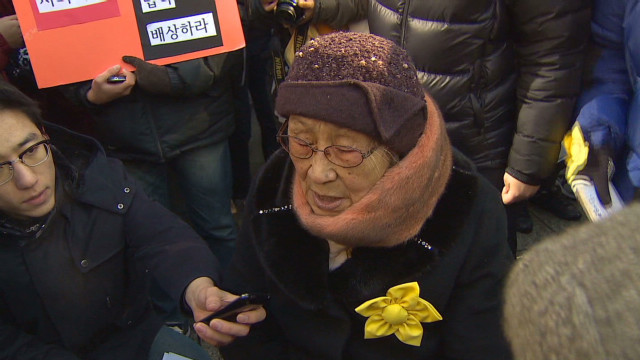
Last Sunday, Hwang Keum-ja, one of the few remaining Korean sex slaves of the Imperial Japanese Army (“comfort women”) passed away in a hospital in Seoul, South Korea. She died of lung and respiratory disease at the age of 89.

Forced into prostitution at the age of 16, Hwang was forced to serve in “comfort stations’ throughout World War II in several conquered countries. The life of these women can only be described as a living hell. On duty seven days a week, they were forced to have sex with as many IJA soldiers as showed up at the brothel. Hwang later said that she was unable to even stand up at the end of most weekends. She endured these torturous circumstances for several years before being abandoned in China at war’s end.

Making her way back to Korea, Hwang survived by collecting and selling garbage from the streets. Late in her life, she suffered hallucinations about being attacked in her home. She lived a life of great poverty, but this did not keep her from becoming one of the most outspoken advocates for the former sex slaves. Right up to the time of her death, Hwang regularly took part in demonstrations outside the Japanese embassy in Seoul demanding a formal apology from Japan and direct reparations to the individual women. There was precedent for their demands.

Early in the Pacific War, the U.S. government unconstitutionally imprisoned over 100,000 Americans of Japanese ancestry in internment camps. These citizens lost everything they had and had to endure concentration camp conditions for the remainder of the war. Nevertheless, thousands of the young men volunteered to serve in the U.S. armed forces. The army formed them into a segregated regimental combat team, the 442nd was the most decorated unit in the entire U.S. Army.

Later U.S. administrations recognized the horrible injustice visited on these Japanese-Americans. Congress passed a resolution of apology and appropriated funds to compensate the internees in part for their suffering. Today’s Americans are appalled that such a thing could have happened in our country. Over 200,000 Korean women were enslaved as IJA “comfort women.” Only 55 of these women are left alive. Hwang Keum-ja and her sisters are asking nothing more than what the U.S. provided to its internees.

My World War II novel, Hold Back the Sun, touches on the IJA sex slave system. A villainous Japanese officer plots to enslave the Dutch heroine as a “comfort woman” for causing him to lose face. He could not conceive of a more terrible fate. Neither could I as the author.

Note: Warren Bell is a historical fiction author with two novels released and for sale either for Kindle or in paperback from Amazon.com. Both are set during WWII, with Fall Eagle One taking place in Europe, and Hold Back the Sun is set in the war in the Pacific.

Saturday, January 18, 2014

Japanese Response to Chinese Ambassador’s Op-Ed


My blog post last week, “Revisiting Japan’s Conduct in the Pacific War,” received a lot of attention. Many people visited the blog all throughout the week. As you’ll recall, the post was prompted by an op-ed in theWashington Post by the ChineseAmbassador to the U.S.

This morning, the Post Editorial Page published a response entitled, “China’s anti-Japan Campaign,” by Kenichiro Sasae, Japan’s ambassador in Washington.  Mr. Sasae basically dismissed the Chinese article as part of an anti-Japanese propaganda campaign. He argues that it is China, not Japan, that threatens the future peace of Asia today.

I found a number of interesting points in Mr. Sasae’s column. This is how he describes the Yasukuni Shrine: 

“a place where the souls of those who sacrificed their lives for the country…have been enshrined. Japanese people visit the shrine to pray for the souls of the war dead—not to glorify war or honor or justify a small number (14) of Class A war criminals.”

This assertion is mostly correct as far as it goes. Honoring war dead as a group is done throughout the world. But it is not necessarily the Shinto shrine but the accompanying museum that sets Asian teeth on edge. Presenting over a dozen Class A war criminals as national heroes is offensive to many of the nations victimized by Japan’s aggression. What would the world think if Germany enshrined Hitler, Goering, Himmler and Admiral Donitz as war gods? Even if the shrine honored all the other German war dead, including these evil men would be an affront to humanity. Men who ordered wholesale atrocities should be roundly condemned, not honored. 

About the war in general, Mr. Sasae reports that, “

“The government of Japan has repeatedly expressed deep remorse and heartfelt apologies regarding the war. So did the prime minister after his recent visit to Yasukuni; he said that ‘Japan must never wage war again’ based on ‘the severe remorse for the past.’”

Japan has apologized for the war in general. However, many of the captives enslaved by Japan had to fight in court for decades to receive an apology and obtain any compensation for their ordeal. The case of the over 200,000 “comfort women” who were sex slaves for the Japanese armed forces is a case in point. In last week’s post, I listed several excellent references on this subject. Half a century elapsed before Japan finally admitted that the “comfort stations” were in fact run by the army. An apology was finally issued. Many politicians still assert that the women became prostitutes voluntarily and were adequately compensated by client fees at the time.  Just Google “comfort women,” and you’ll receive a wealth of information refuting these allegations.

Mr. Sasae’s statement that China is currently much more of a threat than Japan to dominate does resonate.  He bemoans,

“…China’s unparalleled military buildup and its use of military and mercantile coercion against neighboring states. The most recent example of this is Beijing’s unilateral declaration of an air defense identification zone. China has escalated the intrusion of government vessels into the territorial sea of the waters around the Senkaku Islands and in waters claimed by the Philippines.”

Considering the situation in Asia today, Mr. Sasae may be right here. Japan has remained a peaceful nation for over 50 years since World War II. But the acts of Japan’s armed forces during the Pacific War were unquestionably horrific. Their victims may someday be willing to forgive them, but these crimes must never be forgotten.   

Saturday, January 11, 2014

Revisiting Japan’s Conduct During the Pacific War


This morning’s Washington Post contained an editorial entitled Dangerous Tribute by Chu Tiankai, China’s ambassador to the United States and former ambassador to Japan.  Mr. Tiankai logically argues that the recent visit by Japan’s Prime Minister to the Yasukuni Shrine symbolizes support for the view that Japan was not an aggressor and committed no atrocities in World War II.

Several passages in the editorial caught my attention. Here are a few:

“Established in the 19th century to honor Japan’s war dead, the shrine imparted a spiritual dimension to Japanese militarism and colonial rule…”

“Fourteen Class A War criminals who were tried by the International Military Tribunal are honored at Yasukuni.”

“The shrine includes s…a deliberately revisionist narrative of World War II (that) lauds Japan’s salvage of Asian countries from colonial rule and detains ‘crimes committed by the United States.”

“His (the Prime Minister’s) assertions, when talking about World War II, that the term, ‘aggression’ has yet to be defined and that no evidence exists proving that “comfort women” were forced into sexual servitude…”

I have visited the Yasukuni Shrine, and I can confirm that Mr. Tiankai’s assertions about it are correct. The earlier exhibits, which detail modern Japan’s wars prior to their invasion of China in the 1930s, are all both in English and Japanese. From that point forward, only Japanese texts are presented. But, being a World War II buff, I had no problems identifying the portraits of the deified General Tojo and Admirals Yamamoto and Nagumo, who conceived and executed the Pearl Harbor attack. You read that right. In the Shinto religion, these criminals have become war gods.  The Prime Minister’s visit can be construed as worshiping them.

One of the reasons that Japanese soldiers readily obeyed orders to slaughter prisoners and innocent civilians was the provision of their Senjinkun (Field Service Code) that equated an order from a superior as a direct order from the emperor. Hence, an order became a pronouncement from God. Coupled with the Samurai principle that death was better than surrender and that anyone who surrendered had forfeited all honor, the opportunities for abuse became infinite.

A review on Amazon of my novel, Hold Back the Sun, suggested that I was too hard on my Japanese characters. I believe that I may not have been hard enough.  The atrocities I portrayed in my story are all based on actual events of which I learned through exhaustive research. For anyone who remains doubtful, I suggest they read all or some of my following references.  Also look on Google.

1) The Rising Sun by Arthur Zich, Time Life Books, Chapter 3, Under the Conquerors’ Rule. Describes the actual massacres at Balikpapan (in Borneo) and Tjepu(in Java) upon which I based the story of the fall ofZwarte Gouden.

2) The Rape of Nanking by Iris Chang, Basic Books-Publisher. Describes the fall and systematic terrorizing of Nanking in graphic detail. The last word on the subject. Over 300,000 civilians were massacred and countless women raped.

3) But Not in Shame by John Toland. Random House. Relates the rape and murder of British nurses at Hong Kong (mentioned in Hold Back the Sun) and extensive massacres of Chinese immigrants following the fall of Singapore.

4) Hidden Horrors by Yuki Tanaka, Westview Press. A general compendium of Japanese atrocities during World War II.

5) Kempei Tai by Richard Deacon, Charles Tuttle Company. An extensive description of the deeds of Japans infamous military police, who committednumerious atrocities.

6) Prisoners of the Japanese by Gavan Daws, William Morrow and Company. A detailed account of the inhumane treatment received by Allied POWs at the hands of the Japanese.

7) War Without Mercy by John W. Dower, Pantheon Books. A no-holds-barred description of how racism shaped the Pacific War on both sides. Many Japanese atrocities are detailed.

8) The Comfort Women by George Hicks, W.W. Norton & Company. A well-researched and detailed history of sex slavery in the Japanese Army.

9) True Stories of the Korean Comfort Women Edited by Keith Howard, Casswell. A compendium of memoirs by Korean women forced into sexual slavery

10) 50 Years of Silence by Jan Ruff-O’Herne, Toppan Company (s) PTE Ltd. A compelling memoir of a young Dutchwoman who was kidnapped from an internment camp in Java and enslaved as a prostitute for Japanese officers.

In my view, the Japanese government’s continued denial of the savage conduct by her armed forces in China and the Pacific War remains an affront to humankind.


Saturday, October 19, 2013

A Shameful Secret of World War II: Sexual Slavery in the Axis Armies

Korean Comfort Women held by the Japanese Imperial Army

The first scene of my new novel, Hold Back the Sun, takes place in Madam Kitty’s, a posh Gestapo brothel in Berlin. Nazi friends are giving a going-away party for the book’s chief villain, a Japanese Military Attaché.  Madam Kitty’s was an actual establishment located at the address I give it in the novel. Its purpose was to ply foreign diplomats with liquor and sex, and then extract secret information from them during “pillow talk.” All the rooms were bugged to capture the conversations on recordings.


I did not mention it in my novel because it did not fit into the story, but almost all the prostitutes in Madam Kitty’s were in fact sex slaves, the wives and daughters of political prisoners. The Gestapo gave these women a stark choice: become espionage prostitutes or have their loved ones executed.


All three of the Axis armies of World War II were supported by systems of military brothels. Compelling evidence exists that at least the Germans and Japanese employed conscripted sex slaves. What little has been written about the Italian Army suggests that they primarily utilized professional Italian prostitutes.


During the peak years of the war, the German Army and the Gestapo operated some 500 military brothels. Researchers have reported that some 34,000 women conscripted from the conquered races or from concentration camps worked in these entertainment houses. Ironically, when they became, ”worn out,” many were placed in concentration camps for the crime of prostitution. Perhaps because of the utter devastation of Nazi Germany and the fact that Stalin’s Army committed what has been called, ”the greatest mass rape of women in history,” during the conquest of East Germany, the suffering of Germany’s sex slaves has gone largely unmentioned in history.


By far the largest employment of military sex slaves was by the Japanese Army. After discipline broke down during the “Rape of Nanking,” the Army staff decided that providing the soldiers with their own prostitutes was necessary for “good order and discipline.” Detailed planning for the conquest of Southeast Asia included provision of Ianfu (Comfort Women) units down to at least the battalion level. Hard pressed to fill these units with volunteers, the Army resorted to deception and mass kidnappings. During the course of the war, over 200,000 Asian women from territories under Japanese control were conscripted, the vast majority from Korea. But thousands of women from China, the Philippines, Indonesia, Malaya, and other subject nations shared their fate. In Java, some 300 Dutchwomen were also enslaved. At least sixty were kidnapped from internment camps and placed in “comfort stations.” What they endured can only be described as a months long gang rape. Unbelievably, the suffering of “front line” Ianfu was even worse. Many were forced to entertain up to 40 “clients” per day while living in primitive conditions and being fed barely enough food to keep them functioning.   


Very few of the Japanese responsible for these crimes against humanity ever had to pay for their actions. Only those officers and noncoms responsible for the kidnappings and rapes in Java were tried by the Allies after the war. The officer held primarily responsible was hanged. Perhaps because of the racial attitudes of the time, the plight of the Asian women was largely ignored.


During the 1980s and 1990s, many of the former Ianfu came forward to tell their stories and demand compensation. In 1994, one of the Dutchwoman, Jan Ruff-O’Herne, wrote of her ordeal in her book, Fifty Years of Silence. After a long period of outright denial, one Japanese president finally offered something of an apology. A fund was set up for the Comfort Women, but payouts are minimal considering what these war victims endured.


I have long been troubled by the plight of the Japanese Army’s sex slaves. When I began writing HoldBack the Sun, I decided to illuminate these war crimes in my novel. I hope that I have done an adequate job.