Showing posts with label asia. Show all posts

Saturday, March 8, 2014

Sharpening My Perspective on the Vietnam War

During the past few weeks, I have been plugging away on my new novel, Asphalt and Blood: U.S. Navy Seabees in the Battle for Hue City.  Although I’m depending heavily on my notes I took while I was there in the 1960s and interviews with other Seabee veterans, I also remain alert for new material from other sources. I recently found some excellent material on a media I’ve told my readers before not to trust: my television set.

While casting about for anything worthwhile in a barren wasteland last Monday evening, I stumbled onto a pair of Vietnam War shows on the Military Channel.  The American Heroes Channel, a group previously unknown to me, produced both programs. The first revealed newly discovered combat film taken during the Battle of Dak To. The horrors of jungle combat with the superbly equipped, highly professional North Vietnamese Army (NVA) were presented in all their raw detail.  Soldiers were seen being shot and blown apart with mortar bombs exactly as it happened. This was not reenactment. It was taken live during the battle. Combat cameramen went right in with the infantry as they penetrated triple canopy jungle to assault hilltop positions. The program drove home to me that Vietnam was not a homogenized war. It was a number of different wars being fought simultaneously, details depending on terrain and environment. Our troops had widely varying experiences according to where they fought.  When writing about Vietnam, an author must be sure to describe the right war for the geographical setting.

The second show I watched was called Against the Odds and covered the first half of the Battle for Hue City in 1968. I decided to watch the program to refresh my memories of Hue and its surroundings. I was soon struck by how accurate the producers got this one. For the first time I have seen on American television, the Hue battle was portrayed for what it was, a victorious fight against impossible odds by a few half-strength companies of U.S. Marines. During the Tet holiday celebrations, the NVA slipped nine regiments of highly trained troops inside Hue, seizing three fourths of the city overnight. The Marines at Camp Eagle in nearby Phu Bai had no concept of the enemy’s strength. Responding to calls for help from the besieged Military Assistance Command (MACV) compound in South Hue, a force of less that a company of Marines was originally dispatched. This group was heavily engaged by the NVA soon after entering Hue. Calls for reinforcements brought a few more small companies, and the Marines finally reached MACV.

As the overwhelming strength of the NVA became apparent through “reconnaissance in force,“ more individual Marine companies were fed into the battle. They still were unaware that the odds were about 100 to one against them. And this was not the sort of war for which they had been trained. In 1968, Counter-insurgency was the style of fighting American troops expected.  A few Marine captains soon realized that they now had to fight a battle more akin to that in Stalingrad in World War II, street-to-street, house-to-house, room-by-room. Amazingly, the young Marines quickly adapted and began to win these battles in microcosm. They were Americans and had been brought up to think for themselves. They were Marines, a band-of-brothers fiercely loyal to each other and to the Corps. And as one Hue veteran so aptly stated, “There is no fighting machine in the world as destructive as a pissed-off nineteen-year-old Marine.” And so they persevered, although many of them were walking wounded. One wounded captain continued fighting until he collapsed. His men brought him a wounded chaplain, who administered last rites. The captain’s dying words were, “God, please take care of my Marines.” Amazingly, these few hundred kids finishing clearing South Hue to the Perfume River, then boarded landing craft to cross to the north bank. 

Against the Odds closes at this point. The battle for the Hue Citadel was an equally amazing story. These were Nineteenth Century French-designed fortifications of stone blocks and brick enclosing tightly packed residential areas, the former emperor’s compound, and shrines. One paramount fact that the TV program omitted was that the Army of the Republic of Vietnam (ARVN) 1st Division held onto their fortress in the northern corner of the city.  Again, a few companies of Marines entered the walls through the 1st Division compound and fought another house-to-house battle to evict literally regiments of NVA. It was said of the Marines in the Battle of Iwo Jima that, “Uncommon valor was a common virtue.” No less was true of the young Marines at Hue City. One of the tragedies of the Vietnam War was that their accomplishments were not properly recognized at the time. In fact, a large segment of the media ridiculed the battle, arguing that the time it took to retake Hue revealed American ineffectiveness. Such slanted reporting caused many of us that were then “in-country” to lose trust in the veracity of the media.

The Battle for Hue City is central to Asphalt and Blood. My story relates how U.S. Navy Seabees worked alongside the Marines, sharing their familiarity with the city, bridging canals and providing other essential construction support. I hope veterans consider my novel to be as accurate as I found Against the Odds.

Photo Caption: Flagtower Citadel of Huế with NVA flag flying.

Photo Credit: By Arabsalam (Own work) [GFDL (http://www.gnu.org/copyleft/fdl.html) or CC-BY-SA-3.0-2.5-2.0-1.0 (http://creativecommons.org/licenses/by-sa/3.0)], via Wikimedia Commons

Note: Warren Bell is a historical fiction author with two novels released and for sale either for Kindle or in paperback from Amazon.com. Both are set during WWII, with Fall Eagle One taking place in Europe, and Hold Back the Sun set in the war in the Pacific. 


Saturday, March 1, 2014

Women in Early 1940s Japan


Earlier this month, The Japan Times reported that several thousand women in Tokyo had threatened to boycott sex with their husbands if they voted for Yoichi Masuzoe, one of the mayoral candidates in the upcoming election. Masuzoe had made comments at a press conference to the effect that women were unfit to make government decisions because their judgment was that erratic during their monthly period. After Masuzoe won, the same group is calling for all women to boycott sex with any man who voted for him.  Such a movement would have been unthinkable during the early 1940s, the setting for parts of my latest novel, Hold Back the Sun.

In pre-Pacific War Japan, women were decidedly second-class citizens. This had been true since the beginnings of the Samurai Period. The greatest value of women, especially in middle and upper class society, was as child bearers and sex objects to be enjoyed by men. The Japanese viewed sex drive, especially in men, as just another appetite that needed to be consistently satisfied. Among the peasant farmers, of course, women were also valued for their labor in cultivating crops.  When the push towards modernization began in the late 1800s, women were also viewed as a source of industrial labor, at least until they were married.

Women had few freedoms. They were always under the domination of a male. Before marriage, they had to obey their fathers. After marriage, their husbands assumed command. Widows were expected to follow the orders of their oldest son. Nowhere were the words of the old folksong sung by Joan Baez, The Wagoner’s Lad, truer than in Japan:

Oh heartache’s the portion of all womankind,
She’s always controlled; she’s always confined,
Controlled by her parents until she’s a wife,
A slave to her husband the rest of her life

In the home, the wife was the husband’s servant. When he returned from work, she took his coat and made him comfortable, holding his chair while he sat if they used western furniture. She prepared and served the food and was responsible for child care. If her husband was an eldest son, she was required to become his widowed mother’s servant also. If the husband desired sex, she could not refuse him. But the primary job of a wife was not sexual entertainment. It was bearing children to carry on the family. For pure sexual enjoyment, Japanese men frequented geishas and yûjos (courtesans).  Japan’s sex trade was extensive and sophisticated. The pinnacle of the trade was the famous Yoshiwara sex market in Tokyo. Girls as young as twelve were literally sold into this trade by their families. They became sex slaves. Of course, peasant farmers could ill afford to live by this standard. They were more likely to depend on their wives for sexual pleasure.

Some readers of Hold Back the Sun have suggested that I was too harsh on the Japanese arch-villain. But considering the culture in which he was brought up, is it any wonder that he viewed women primarily as sex objects? Or that he considered them incapable of complex thinking. As one of the militarist ultra-nationalists, he would have harbored hatred for European colonialists for the subjugation of Asians. Such a man would have been ashamed and enraged to lose a bridge tournament to a “mere woman,” and a white one at that. He would view revenge in the form of sexual slavery as a matter of simple justice.

The position of women improved a great deal after General Douglas MacArthur and his staff wrote political sexual equality for women into the new Japanese constitution. Women today are much more independent. A large percentage of educated young women have discovered that they don’t need a man to support them. Almost forty percent of these women are refusing to marry and assume the role of servants. A poll showed that about 30 percent of all Japanese between 18 and 30 years old have never had even one date.  Yet the attitudes of some politicians like Yoichi Masuzoe indicate that men still have a way to go in their attitudes. It will be interesting to learn how the boycott turns out.


Much of the information in this post was drawn from Cities of Sin, a 1930s publication of the League of Nations Commission on White Slavery.

Note: Warren Bell is a historical fiction author with two novels released and for sale either for Kindle or in paperback from Amazon.com. Both are set during WWII, with Fall Eagle One taking place in Europe, and Hold Back the Sun is set in the war in the Pacific. 


Sunday, February 2, 2014

Another Voice of Anguish Stilled


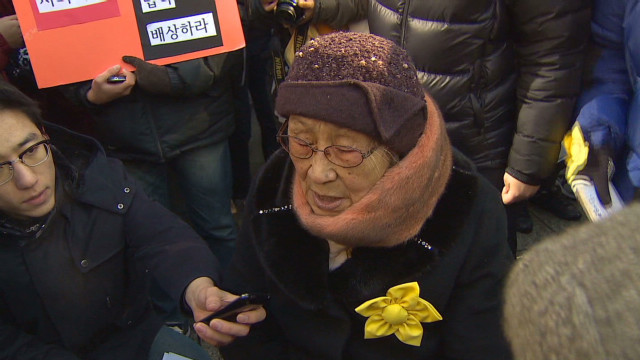
Last Sunday, Hwang Keum-ja, one of the few remaining Korean sex slaves of the Imperial Japanese Army (“comfort women”) passed away in a hospital in Seoul, South Korea. She died of lung and respiratory disease at the age of 89.

Forced into prostitution at the age of 16, Hwang was forced to serve in “comfort stations’ throughout World War II in several conquered countries. The life of these women can only be described as a living hell. On duty seven days a week, they were forced to have sex with as many IJA soldiers as showed up at the brothel. Hwang later said that she was unable to even stand up at the end of most weekends. She endured these torturous circumstances for several years before being abandoned in China at war’s end.

Making her way back to Korea, Hwang survived by collecting and selling garbage from the streets. Late in her life, she suffered hallucinations about being attacked in her home. She lived a life of great poverty, but this did not keep her from becoming one of the most outspoken advocates for the former sex slaves. Right up to the time of her death, Hwang regularly took part in demonstrations outside the Japanese embassy in Seoul demanding a formal apology from Japan and direct reparations to the individual women. There was precedent for their demands.

Early in the Pacific War, the U.S. government unconstitutionally imprisoned over 100,000 Americans of Japanese ancestry in internment camps. These citizens lost everything they had and had to endure concentration camp conditions for the remainder of the war. Nevertheless, thousands of the young men volunteered to serve in the U.S. armed forces. The army formed them into a segregated regimental combat team, the 442nd was the most decorated unit in the entire U.S. Army.

Later U.S. administrations recognized the horrible injustice visited on these Japanese-Americans. Congress passed a resolution of apology and appropriated funds to compensate the internees in part for their suffering. Today’s Americans are appalled that such a thing could have happened in our country. Over 200,000 Korean women were enslaved as IJA “comfort women.” Only 55 of these women are left alive. Hwang Keum-ja and her sisters are asking nothing more than what the U.S. provided to its internees.

My World War II novel, Hold Back the Sun, touches on the IJA sex slave system. A villainous Japanese officer plots to enslave the Dutch heroine as a “comfort woman” for causing him to lose face. He could not conceive of a more terrible fate. Neither could I as the author.

Note: Warren Bell is a historical fiction author with two novels released and for sale either for Kindle or in paperback from Amazon.com. Both are set during WWII, with Fall Eagle One taking place in Europe, and Hold Back the Sun is set in the war in the Pacific.

Saturday, January 25, 2014

The Pacific War was About Oil


In the latter part of his life, U.S. Navy Admiral Hyman Rickover predicted that the next wars the United States fought would be over access to oil. His conclusions proved remarkably accurate. The last ten years have seen the U.S. involved in conflicts in the Middle East, source of some of the world’s largest oil reserves.


For several decades, the U.S. has been a net oil importer. As local reserves diminished, it proved too easy to just replace them with foreign purchases. The point that modern industrial society cannot support itself without reliable sources of energy seemed to be forgotten. Then the Arab Oil Embargo of the 1970s shattered our illusions. The United States had become an an oil “have-not.”


Japan faced an energy crisis in 1941 that led directly to their attack on western colonies in the Far East. Since the opening of Japan to world trade by Admiral Perry in the mid-Nineteenth Century, the country had been striving to become a modern industrialized nation. From an archaic feudal society, the country made a great leap forward into the modern world. Desiring all the trappings of a major power, Japan turned to Germany to build her army and to Great Britain to construct an up-to-date navy. Consultants from all over the world helped develop their heavy industry.


Japan lacked one key ingredient to fulfill their aspirations—a local supply natural resources. Like many nations, they were forced to purchase them abroad. The U.S. was a major player in this trade, becoming Japan’s major source of oil and the scrap iron required to produce steel. While fostering world trade, these imports created a balance of payments problem for the Japanese. They successfully negotiated this situation until the 1920s.


The Great Depression hit Japan particularly hard. The hardships being endured prompted many ultra nationalists in the armed forces to advocate seizing the needed resources from their neighbors. Everything they needed waited just over the horizon. As more and more recruits joined their ranks, these aggressive thoughts were translated into action. The semi-autonomous Kwantung Army in Korea invaded and occupied Manchuria with its rich mineral deposits. When the League of Nations protested, Japan walked out.  Then, in 1937, Japan invaded China itself,

beginning a protracted conflict.


Long committed to its “Open Door” policy concerning China, the U.S. protested. Inspired by Pearl S. Buck’s novels and Hollywood movies, many Americans held romanticized views of China. The Japanese, however, persisted in their conquests. Sentiment built in the Roosevelt administration to impose sanctions on Japan.


When Japan occupied French Indochina (now Vietnam) in 1941, Washington finally acted, freezing Japanese assets in the U.S. This had the immediate effect of shutting off exports to Japan.  The U.S. oil tap was suddenly turned off. The finite reserves of petroleum products within Japan became a wasting asset.  Japan’s civilian government began negotiations with the U.S., attempting to find an acceptable resolution to the crisis. The ultra nationalists in the Army began pushing for a military solution.


One faction advocated invading Siberia. Hitler’s armies were, after all, at the gates of Moscow. The navy argued for a quick strike to the south. The lightly defended Dutch East Indies (Indonesia today) possessed a mammoth oil industry exploiting huge underground reserves.  The oilfields on Tarakan Island yielded crude so pure that it could be burned in boilers without refining. The Royal Dutch Shell refinery at Balikpapan in Borneo was the world’s third largest, producing sufficient product to satisfy the navy’s entire needs.


Two major obstacles fell in the way of the southern plan: The British forces stationed at Fortress Singapore and the U.S. forces in the Philippine Islands. Britain was stretched to the limit in her war with Germany, but the U.S. was not yet a belligerent. Roosevelt had moved the U.S. Pacific Fleet to Pearl Harbor, where it could respond quicker to trouble in the Philippines.


The brilliant General Tomoyuki Yamashita devised a workable plan to capture Singapore from inland. Navy Admiral Yamamoto’s staff conceived the idea of destroying the U.S. Pacific Fleet in port at the outset of hostilities, delaying America’s intervention. Then Washington further shocked Tokyo with a demand that Japan withdraw from China before sanctions would be lifted. The civilian government in Tokyo collapsed, and General Tojo became Prime Minister. Faced with the humiliation of withdrawal or exhaustion of fuel supplies, Tojo argued for war. With the Emperor’s approval, the date for hostilities to commence was set.


For the first six months, Japan ran wild in the Far East, seizing all the territories in their ambitions. Ironically, the Dutch Oil executives adopted a “scorched earth” policy. Nothing was to be left to the invaders. They plugged oil wells, blew up pipelines and set fire to their precious refineries. When the Japanese invaded Balikpapan, they found only burnt, twisted wreckage at the oil facilities. The enraged Japanese commander ordered the massacre of the entire Caucasian population. Some were beheaded. Most were machine gunned in the surf. A similar massacre of Dutch males occurred in Tjepu, Java.


Japan soon had the oilfields back in operation and new refineries constructed. Oil was not a problem again until U.S. submarines sank a large percentage of their tankers later in the war.


The philosopher, George Santayana, observed that nations that do not study history are doomed to repeat it. After three wars to assure oil supplies, the U.S. should develop its newly discovered oil reserves and strive for energy independence.

Note: Warren Bell is a historical fiction author with two novels released and for sale either for Kindle or in paperback from Amazon.com.  Both are set during WWII, with Fall Eagle One taking place in Europe, and Hold Back the Sun is set in the war in the Pacific.


Saturday, January 18, 2014

Japanese Response to Chinese Ambassador’s Op-Ed


My blog post last week, “Revisiting Japan’s Conduct in the Pacific War,” received a lot of attention. Many people visited the blog all throughout the week. As you’ll recall, the post was prompted by an op-ed in theWashington Post by the ChineseAmbassador to the U.S.

This morning, the Post Editorial Page published a response entitled, “China’s anti-Japan Campaign,” by Kenichiro Sasae, Japan’s ambassador in Washington.  Mr. Sasae basically dismissed the Chinese article as part of an anti-Japanese propaganda campaign. He argues that it is China, not Japan, that threatens the future peace of Asia today.

I found a number of interesting points in Mr. Sasae’s column. This is how he describes the Yasukuni Shrine: 

“a place where the souls of those who sacrificed their lives for the country…have been enshrined. Japanese people visit the shrine to pray for the souls of the war dead—not to glorify war or honor or justify a small number (14) of Class A war criminals.”

This assertion is mostly correct as far as it goes. Honoring war dead as a group is done throughout the world. But it is not necessarily the Shinto shrine but the accompanying museum that sets Asian teeth on edge. Presenting over a dozen Class A war criminals as national heroes is offensive to many of the nations victimized by Japan’s aggression. What would the world think if Germany enshrined Hitler, Goering, Himmler and Admiral Donitz as war gods? Even if the shrine honored all the other German war dead, including these evil men would be an affront to humanity. Men who ordered wholesale atrocities should be roundly condemned, not honored. 

About the war in general, Mr. Sasae reports that, “

“The government of Japan has repeatedly expressed deep remorse and heartfelt apologies regarding the war. So did the prime minister after his recent visit to Yasukuni; he said that ‘Japan must never wage war again’ based on ‘the severe remorse for the past.’”

Japan has apologized for the war in general. However, many of the captives enslaved by Japan had to fight in court for decades to receive an apology and obtain any compensation for their ordeal. The case of the over 200,000 “comfort women” who were sex slaves for the Japanese armed forces is a case in point. In last week’s post, I listed several excellent references on this subject. Half a century elapsed before Japan finally admitted that the “comfort stations” were in fact run by the army. An apology was finally issued. Many politicians still assert that the women became prostitutes voluntarily and were adequately compensated by client fees at the time.  Just Google “comfort women,” and you’ll receive a wealth of information refuting these allegations.

Mr. Sasae’s statement that China is currently much more of a threat than Japan to dominate does resonate.  He bemoans,

“…China’s unparalleled military buildup and its use of military and mercantile coercion against neighboring states. The most recent example of this is Beijing’s unilateral declaration of an air defense identification zone. China has escalated the intrusion of government vessels into the territorial sea of the waters around the Senkaku Islands and in waters claimed by the Philippines.”

Considering the situation in Asia today, Mr. Sasae may be right here. Japan has remained a peaceful nation for over 50 years since World War II. But the acts of Japan’s armed forces during the Pacific War were unquestionably horrific. Their victims may someday be willing to forgive them, but these crimes must never be forgotten.   

Saturday, January 11, 2014

Revisiting Japan’s Conduct During the Pacific War


This morning’s Washington Post contained an editorial entitled Dangerous Tribute by Chu Tiankai, China’s ambassador to the United States and former ambassador to Japan.  Mr. Tiankai logically argues that the recent visit by Japan’s Prime Minister to the Yasukuni Shrine symbolizes support for the view that Japan was not an aggressor and committed no atrocities in World War II.

Several passages in the editorial caught my attention. Here are a few:

“Established in the 19th century to honor Japan’s war dead, the shrine imparted a spiritual dimension to Japanese militarism and colonial rule…”

“Fourteen Class A War criminals who were tried by the International Military Tribunal are honored at Yasukuni.”

“The shrine includes s…a deliberately revisionist narrative of World War II (that) lauds Japan’s salvage of Asian countries from colonial rule and detains ‘crimes committed by the United States.”

“His (the Prime Minister’s) assertions, when talking about World War II, that the term, ‘aggression’ has yet to be defined and that no evidence exists proving that “comfort women” were forced into sexual servitude…”

I have visited the Yasukuni Shrine, and I can confirm that Mr. Tiankai’s assertions about it are correct. The earlier exhibits, which detail modern Japan’s wars prior to their invasion of China in the 1930s, are all both in English and Japanese. From that point forward, only Japanese texts are presented. But, being a World War II buff, I had no problems identifying the portraits of the deified General Tojo and Admirals Yamamoto and Nagumo, who conceived and executed the Pearl Harbor attack. You read that right. In the Shinto religion, these criminals have become war gods.  The Prime Minister’s visit can be construed as worshiping them.

One of the reasons that Japanese soldiers readily obeyed orders to slaughter prisoners and innocent civilians was the provision of their Senjinkun (Field Service Code) that equated an order from a superior as a direct order from the emperor. Hence, an order became a pronouncement from God. Coupled with the Samurai principle that death was better than surrender and that anyone who surrendered had forfeited all honor, the opportunities for abuse became infinite.

A review on Amazon of my novel, Hold Back the Sun, suggested that I was too hard on my Japanese characters. I believe that I may not have been hard enough.  The atrocities I portrayed in my story are all based on actual events of which I learned through exhaustive research. For anyone who remains doubtful, I suggest they read all or some of my following references.  Also look on Google.

1) The Rising Sun by Arthur Zich, Time Life Books, Chapter 3, Under the Conquerors’ Rule. Describes the actual massacres at Balikpapan (in Borneo) and Tjepu(in Java) upon which I based the story of the fall ofZwarte Gouden.

2) The Rape of Nanking by Iris Chang, Basic Books-Publisher. Describes the fall and systematic terrorizing of Nanking in graphic detail. The last word on the subject. Over 300,000 civilians were massacred and countless women raped.

3) But Not in Shame by John Toland. Random House. Relates the rape and murder of British nurses at Hong Kong (mentioned in Hold Back the Sun) and extensive massacres of Chinese immigrants following the fall of Singapore.

4) Hidden Horrors by Yuki Tanaka, Westview Press. A general compendium of Japanese atrocities during World War II.

5) Kempei Tai by Richard Deacon, Charles Tuttle Company. An extensive description of the deeds of Japan’s infamous military police, who committednumerious atrocities.

6) Prisoners of the Japanese by Gavan Daws, William Morrow and Company. A detailed account of the inhumane treatment received by Allied POWs at the hands of the Japanese.

7) War Without Mercy by John W. Dower, Pantheon Books. A no-holds-barred description of how racism shaped the Pacific War on both sides. Many Japanese atrocities are detailed.

8) The Comfort Women by George Hicks, W.W. Norton & Company. A well-researched and detailed history of sex slavery in the Japanese Army.

9) True Stories of the Korean Comfort Women Edited by Keith Howard, Casswell. A compendium of memoirs by Korean women forced into sexual slavery

10) 50 Years of Silence by Jan Ruff-O’Herne, Toppan Company (s) PTE Ltd. A compelling memoir of a young Dutchwoman who was kidnapped from an internment camp in Java and enslaved as a prostitute for Japanese officers.

In my view, the Japanese government’s continued denial of the savage conduct by her armed forces in China and the Pacific War remains an affront to humankind.


Friday, January 3, 2014

Shifting My Mind to a Different War


I spent yesterday afternoon polishing the draft of the first chapter of my new novel, Asphalt and Blood. To do so, I had to shift the focus of my mind forward a good twenty years. My first two novels, Fall EagleOne and Hold Back the Sun, take place during the Second World War. Asphalt and Blood tells the story of how the U.S. Navy’s Seabees helped the Marines retake Hue City during the 1968 Tet Offensive.

As I worked through my manuscript, I was mentally transported back to Vietnam during the war there. I spent seventeen months “in country” during two tours as the Operations Officer of a Seabee battalion. My second deployment was to Hue/Phu Bai to the north of Danang. We first arrived there less than six months after the Tet battle, and I became very familiar with the area over the next nine months. Talking with people who were there, I learned that Seabees had a significant presence during the fighting. Thus was born the spark that led to my present project.


After over forty years, my memories of Vietnam are still vivid. Most Americans think of that country as one big rain forest. This may be true of the far south, but the areas in which the Seabees mostly worked were quite different. The northern part of the former Republic of Vietnam is more like parts of Southern California, with rolling hills covered with scrub growth. The beaches along the South China Sea are wide bands of fine white sand—a beautiful tourist area waiting to be developed. The coastal plains around Hue are a sea of iridescent green rice fields stretching from the blue mountains inland to the sea. Given the climate and peace, the farmers there can grow three rice crops per year. These wiry people are some of the hardest working in the world. Our problem was that some were carrying AK-47s after dark.

Another reason I wanted to write Asphalt and Blood is to tell the story of the Seabees in popular fiction. Many of us who served there found our experiences far different from what most Americans envision. Reading press reports during the Tet Offensive, we began to wonder what war the reporters were viewing. What those of us there witnessed was akin to the Battle of the Bulge in 1944. The VC that came out to fight in big unit battles had some initial successes but were then savaged by American forces. From that point forward, the principal enemy was the North Vietnamese Army. Tactically, the Tet Offensive, launched over the objections of Field Marshall Giap, was a disaster. The media turned it into a political victory for the enemy.

I still hesitate to believe everything I see in press reports. Thirty years later, when members of my family were serving in Iraq, I asked them about their take on reports on that war. Their answers were that media reports bore small resemblance to what was actually happening. Don’t get me wrong. I am a staunch defender of press freedom. I just believe that reporters have a responsibility to “tell it like it is.”

Asphalt and Blood is scheduled for release next Labor Day.  As far as exhaustive research will allow, readers should expect an accurate description of the Battle of Hue City.

Note: Warren Bell is a historical fiction author with two novels released and for sale either for Kindle or in paperback from Amazon.com.  Both are set during WWII, with Fall Eagle One taking place in Europe, and Hold Back the Sun is set in the war in the Pacific.

Friday, November 15, 2013

Retrospective on Half a Century

This week has been one of mixed emotions for me. Monday, of course, was Veterans Day. My heart warmed to see the many expressions of gratitude being poured out to today’s veterans. The “thank you for your services” filled the television and computer screens. This is as it should be. The young men and women who fight our country’s wars today do so by choice. They risk their lives daily for our protection, and the whole country should be grateful.

But Veteran’s Day also brought reminders of the war in which I participated—the one in Vietnam. An article in the Washington Post eloquently related the long struggle of the women who nurtured our wounded soldiers in that conflict to obtain recognition at the Vietnam Memorial. A quote from one of the women released memories I had tried to suppress, “We were bitter and angry about how the country treated the Vietnam generation.” It was bad enough that the young men, mostly conscripted against their will, who fought in Southeast Asia were branded “war criminals” and “baby killers” by the antiwar movement. How could they have been so petty and small-minded as to throw the same epithets at women who devoted exhaustive hours to saving the lives of our wounded soldiers?

Many of us who served in Vietnam considered ourselves the “Tommy Atkins” generation. For those of you who have not read Rudyard Kipling’s classic lament of Victorian soldiers, here’s a little background. Tommy Atkins was the phrase Brits use in place of our “G I Joe.”  Here’s a sample:

         I went into a public-'ouse to get a pint o' beer,

The publican 'e up an' sez, "We serve no red-coats here.
"
The girls be'ind the bar they laughed an' giggled fit to die,

I outs into the street again an' to myself sez I:

O it's Tommy this, an' Tommy that, an' "Tommy, go away";

But it's "Thank you, Mister Atkins", when the band begins to play,

The band begins to play, my boys, the band begins to play,

O it's "Thank you, Mister Atkins", when the band begins to play.”

The poem goes on through several verses describing the indignities thrown at Victorian soldiers by an unappreciative public and concludes:

For it's Tommy this, an' Tommy that, an' "Chuck him out, the brute!
"
But it's "Saviour of 'is country" when the guns begin to shoot;

An' it's Tommy this, an' Tommy that, an' anything you please;

An' Tommy ain't a bloomin' fool -- you bet that Tommy sees!

In his speech accepting the Democratic nomination for president, John Kerry opined that many “blamed the warrior rather than the war” for Vietnam. He got that right.

The other factor that made this past week melancholy for me was the 50-year retrospective programs on the assassination of President John Kennedy. Anyone alive and adult at that time can tell you exactly where he or she was when they heard the shattering news. The very idea that such a thing could happen in modern day America was unthinkable. The entire country was plunged into grief. Kennedy had just led us through perhaps the most perilous time in our history—the Cuban Missile Crisis. Few people realized at the time how very close to nuclear Armageddon the world came in those few weeks. For people my age, the killing of the President began a long series of events that harmed our country: The assassinations of Dr. Martin Luther King and Robert Kennedy; the Watergate scandal; push-pull inflation that ravaged the economy; the national disunity over the Vietnam War; the double-digit inflation and interest rates of the Carter Administration.

Winning the Cold War under President Reagan removed the threat of nuclear annihilation but seems to have made the world safe for smaller conflicts. No one is afraid of sucking in the Great Powers and causing a world war anymore. I have a liberal friend who has told me, “Sometimes I miss the Cold War.”

One thing about having lived many years is that today’s challenges don’t seem so overpowering anymore. There’s not much my generation hasn’t faced before and somehow overcome. Humankind continues to adapt and survive. All may not be right with the world, but God’s still in His heaven.
Note: Warren Bell is a historical fiction author with two novels released and for sale either for Kindle or in paperback from Amazon.com.  Both are set during WWII, with Fall Eagle One takes place in Europe, and Hold Back the Sun is set in the war in the Pacific.

Saturday, October 26, 2013

Birth of a Novel

Yesterday, we successfully launched the paperback version of my new novel, Hold Back the Sun. This was my first experience of a formal launch event, but I really enjoyed it. After reading several passages that introduced the main characters and set the tone for the story, I invited the guests to ask questions. Several people asked, “How long does it take to write a novel?”

The answer to this question varies with individual books. Like mammals, different novels have different gestation periods, varying by size. Gerbils take about 25 days from conception to birth; cats require about 64; Horses, 340; African elephants, 645. In similar fashion, the bigger the book, the longer it takes to complete it.

My first published novel, Fall Eagle One required about three years from conception to final draft. The nature of my writing requires somewhat exhaustive historical research. Having the Internet available was a Godsend to my research. Actual writing took a little over a year, while editing and rewriting under the guidance of a skilled editor required several more months before we were ready to shop the manuscript. 

Hold Back the Sun took a little longer. My interest in the exploits of the U.S. Asiatic Fleet early in WWII was sparked in the mid 1960s by reading John Toland’s popular history, But Not in Shame. In the late 1970s, I read The Lonely Ships, Edwin P. Hoyt’s history of the Asiatic Fleet. The germ of an idea for a novel started tickling my mind. I was on active duty in the Navy, so my time for exploring the subject was limited. Nevertheless, I began doing literary research and taking notes on the places I visited in Hawaii and Asia. I began serious writing about 1980 during off duty hours while serving a tour without my family. The result of this effort was a manuscript that was far too long to expect to be published as a debut novel. New writing ideas drew my attention, so Hold Back the Sun languished in my computer for several years. However, I was very attached to the story and always meant to publish it when the opportunity arose.

Once Fall Eagle One achieved some success, I decided to buckle down and rewrite Hold Back the Sun. Using skills learned from my editor, I pared the manuscript and completely rewrote the last third of the story. It took me about seven months of hard work to get to the point of publication. The success of the Kindle e-book (currently #6 in historical fiction-Asian) suggests that it was worth the effort.

Being in my late seventies, I no longer have the luxury of a taking a lot of time for my future works. Fortunately, I can now do most of my research by computer without leaving my desk. I plan to publish one new book every year for as long as I’m physically able.  I hope that my readers will continue to enjoy them.

Note: Both of Warren’s novels are Amazon Kindle Bestsellers Hold Back the Sun is #6 on historical fiction: Asian and #56 in action-adventure: war and military. Fall Eagle One is #56 on action-adventure/war and military.