Monday, August 19, 2013

The Movies Expanded Our Horizons

Rialto Theater, Eldorado Arkansas.
Photo courtesy of Cinema Treasures.
Life in Southwest Arkansas during the 1940s and early 1950s was much more like that of the Nineteenth Century than what we are experiencing today. The majority of the population still lived in the country, even those whose fathers worked in the booming oil industry. Many farmers still plowed behind mules. The roads held a variety of old vehicles, many Ford Model A's and even a few Model T's. Electricity, natural gas, and indoor plumbing were luxuries reserved for those who lived within the limits of cities. Electronic entertainment was usually limited to a single radio powered by a rechargeable battery. I sometimes feel that my grandchildren find my tales of these “days of yore” hard to believe.

Life, however, followed simple rhythms that were centuries old. Daily life centered around hard daily work--but weekends brought a reprieve. Whole families packed into family cars for the weekly shopping trip to the small cities. Even on these outings, a regular routine prevailed. Parents not wanting to corral whiny children had a ready source of childcare—the local movie theater. Saturday offerings included double features, usually “shoot-em-up” westerns, separated by newsreels and serials like “The Perils of Pauline." The films ran continuously. Parents could just drop off their kids with a couple of dimes for admission and candy and leave them there indefinitely. When shopping was finished, the theaters let people go in free to retrieve their offspring. A stop at the local hamburger joint for supper capped the day.

Gradually, long exposure to motion pictures began to change our perception of the world around us. Not all of the movies were westerns. Pictures like Dragon Seed, Pearl S. Buck’s story of harsh Chinese life under Japan’s domination, opened our eyes to other cultures. Tarzan shows and movies like "King Solomon’s Mines" introduced us to Africa. Despite heavy propaganda, newsreels and war movies made us aware of the vast scope of military operations throughout the world. After the war, cinemas shot at exotic locations throughout the world further broadened our horizons. My initial interest in engineering was sparked by a John Wayne movie called "Tycoon," about construction of a railroad in South America.

During my adolescent years, I must have seen nearly every movie that screened in our hometown. For years, I carried an afternoon paper route. The best way to escape the heat of scorching South Arkansas summers was in an air-conditioned movie theater. Frequently viewing images of the world at large fueled a desire to experience a life outside the limits of small town America. By working hard and getting a college education, I was able to live that dream--two degrees in Civil Engineering opened the door, and a long career as an officer in the U.S. Navy took me to many parts of the world, fulfilling childhood dreams.

One of the pictures I saw late in World War II was "The Story of Dr. Wassell,"somewhat fictionalized Cecil B.DeMille epic about a U.S. Navy doctor’s heroism in saving a number of badly wounded sailors from capture by the Japanese. Gary Cooper played the hero. It never occurred to me at the time that, decades later, I would relate the true facts surrounding Dr. Wassell in one of my novels. When I decided to write a novel about the early months of the war in the western Pacific, I was not even thinking about the doctor’s story. I concentrated for months on the savage battles between the vastly outnumbered American and Dutch navies against the modern Imperial Japanese Navy. When I began plotting the final chapters, however, it became apparent that no book about the Dutch East Indies campaign would be complete without including the story of these survivors of U.S.S. Marblehead and U.S.S. Houston. I employed artistic license to place my fictional characters in the midst of this heroic tale. The result is my second novel, recently released for Kindle, Hold Back the Sun.

Just as I could never have anticipated how the technology of the movies would impact my own life so directly, I often wonder, with awe and curiosity, how lives so seemingly-saturated by technology and media today will affect the adult lives of my grandchildren.

Note: Warren Bell's newest novel, Hold Back the Sun, has been released for Kindle in advance of the printed book launch. This new historical-fiction thriller, set in the Pacific, follows the US Asiatic Fleet in their battle with the Japanese.  Warren Bell's debut novel, Fall Eagle One, detailing a fictitious but plausible assassination attempt on FDR during World War II, is available for Kindle or in paperback on Amazon.com.

Saturday, August 10, 2013

Never Lose Your Sense of Wonder


By Alan Vernon [CC-BY-2.0 (http://creativecommons.org/licenses/by/2.0)], via Wikimedia Commons

I love to gaze out the bay window in my kitchen while reading the morning newspaper. A few days ago, I watched a Monarch butterfly and a black Swallowtail butterfly perform a delicate ballet as they grazed on the white flowers of a Crepe Myrtle. My pleasure multiplied when a green hummingbird joined in the dance. I sat mesmerized for several minutes as the flying creatures moved about the plant, feeding from nature’s bounty. Then the bird buzzed away, breaking the spell.

Although I’m closer to 100 than 50 years old, I have never lost my child-like sense of wonder. The intricacies of the world around us are still amazing to me. When I go out on a clear night, I am at once reminded of the psalmist’s poem, “When I gaze upon the night sky and consider all the works thy hand has made…what is man that you are mindful of him?” We live in an awe-inspiring universe, the parts of which move according to immutable physical laws that have existed for eons.

The world is filled with beauty—the fragrant blooms of flowers, the towering waterfalls at Yosemite, the fluffy white clouds of a summer afternoon. Human beings can also be beautiful. Two weeks ago, I met a woman who is 93 years old.  Her eyes sparkled with life. She was sharp as a tack and in excellent physical condition. She was still beautiful. Beauty is not exclusively for the young.

I believe that a sense of wonder is an essential element of a fiction writer’s toolbox. Wonder inspires our creative juices, sharpening our ability to write compelling descriptions. One of my favorite reviews of my novel, Fall Eagle One, contained the phrase, “I felt that I was there!” I do not feel that a writer could receive higher praise.

Saturday, August 3, 2013

Researching My New Novel Hold Back the Sun


My second novel, newly released for Kindle, Hold Back the Sun is set during the opening months to the Pacific War around the Philippine Islands and the Dutch East Indies. I first became interested in this period of the war when I read John Toland’s 1960s popular history of the campaign, But Not in Shame. Not much else became available on the subject for a number of years.

When I decided to write a novel about the early months of the war, the resources for researching the Japanese conquest of Southeast Asia were mostly limited to old books published during the war or immediately thereafter. After framing the basic story in an outline, pressures of my job required that I put it aside for several years. In the interim, a marvelous tool, the Internet, became available. From a scarcity of sources about my project, I suddenly faced a flood of information.

Almost everything I wanted to know was suddenly at my fingertips. An excellent website on The Netherlands East Indies Campaign provided intimate detail about all the units and battles from both the viewpoints of both the Allies and the Japanese. Wikipedia has articles on every subject imaginable. Google Maps allows one to zoom in on any area in the world in both map and satellite formats. Simply Googling the names of historical characters brought up biographies and photos from several sources.  Historical photos of cities throughout the planet can be found with little effort, a boon when describing settings. Old newspaper articles from the period are readily available. A simple email to an Australian city prompted a reply with the address of the 1942 U.S. Navy headquarters there.

Perhaps the most help provided by the Internet was in tracing the saga of Lieutenant Commander Corydon Wassell, USNR Medical Corps. Dr. Wassell became a legend during the war for his heroic efforts in saving a number of wounded U.S. Navy sailors in Java. Wartime propaganda shrouded the actual facts of his heroism. Cecil B. DeMille’s 1944 movie, The Story of Dr. Wassell, did not let the truth get in the way of telling a compelling adventure. Many Internet sources cleared up these discrepancies. Wartime newspaper stories recorded Dr. Wassell’s own account of events as well as reporting the return of his sailors to their hometowns after the conflict. The websites, U.S.S.Marblehead & Dr. Wassell and its link to The Marby website are rich in detail on the Asiatic Fleet in the Southwest Pacific Campaign.

Not all information I needed was available online. William J. Dunn’s 1988 memoir, Pacific Microphone, proved especially helpful, as did Walter D. Edmond’s Air Corps history, They Fought With What They Had (out of print.)

The Internet remains a priceless tool for researching novels, but old fashioned digging in published books is also essential.

Check my Author’s website at https://sites.google.com/site/warrenbellauthor/ for details about the release of Hold Back the Sun.

Friday, July 26, 2013

When Weapons and Equipment Become Characters

Until the last quarter of the Twentieth Century, weapons and equipment in novels were usually only vaguely described. C. S. Forester proved an exception, as did F. Van Wick Mason. Forester described the vessels, cannon, and small arms of the British Royal Navy during the Napoleonic Wars in some detail. Mason did likewise in his historical novels about the American Revolution.  This was one reason I was drawn to their work. However, they remained the exception rather than the rule.

In 1984, the Naval Institute Press published Tom Clancy’s novel, The Hunt for Red October. In 1986, the publisher followed up with Stephen Coonts’s Flight of the Intruder.  Rich in detailed descriptions of up-to-date military weapons and equipment, these books issued in a new genre, the techno-thriller.  Both became runaway best sellers.  Dozens, perhaps hundreds of authors emulated their style. I confess to being one of them.

When I began my first novel, Fall Eagle One, I set out from the beginning to write a World War II techno-thriller.  During the latter years of the war, Germany made giant leaps in aviation and weapons technology. Many historians believe that, had Hitler encouraged rather than hindered these developments earlier, the tide of battle might have turned.  His insistence that the Me-262 jet fighter carry bombs delayed its widespread introduction by at least a year. The specter of hundreds of jet fighters attacking our 8th Air Force bombers as early as 1943 is not pleasant to contemplate. He even initially cancelled production of the MP-44, the world’s first assault rifle. He considered nuclear physics to be “Jewish physics,” and therefore to be spurned.  Germany’s failure to speed development and deployment of all these new “cutting edge” technologies presents many “what-if” ideas for novelists.

The inanimate protagonists I chose for Fall Eagle One are the Messerschmitt-264  inter-continental bomber (Amerika Bomber) and two radio-controlled bombs, the Ruhrstahl  FritzX and the Henschel Hs 293. The Me-264 bore a striking resemblance to the Boeing B-29 and had a range to reach the U.S. East Coast. Both the glide bombs sank major warships, including the Italian battleship, Roma. Fall Eagle One marries these weapons in a mission to the U.S. to kill FDR. I purposefully included the level of descriptive detail employed by Clancy and Coonts. Since I am an engineer, I felt confident in fictionally equipping the bomber with more powerful engines and using actual in-flight refueling technology from the era to extend range. During my extensive research on these weapons, I realized that they were becoming major characters of the novel.

Most of the 5-star reviews of FallEagle One on Amazon.com specifically praise my level of descriptive detail. A few of the less-than-flattering 3-star reviews criticize it. With about a 7:1 ratio of 5-star to 3-star reviews, I can live with that ratio.

My second novel, Hold Back The Sun, is set in the Western Pacific during the opening months of the Pacific War. In relating the heroic battles of the U.S. Asiatic Fleet against the Japanese Navy, I describe the ships and aircraft in a fashion similar to that of C.S. Forester.

I believe that the concept of weapons and equipment as major characters is here to stay in the historical and thriller genres. I hope it at least lasts as long as I am able to continue writing and reading.

Saturday, July 20, 2013

My Love Affair With Historical Fiction


I fell in love with historical fiction when I was fifteen years old.  It happened at a most improvident time—during final exams for ninth grade. To take a break from full-time studying, I bought a copy of the 25-cent paperback version of Samuel Shellabarger’s The Captain From Castile at the Safeway store where I worked. After only a few pages, I became enraptured. Set in the early Sixteenth Century, the novel tells the tale of a young Spanish nobleman who escapes the clutches of the Inquisition to flee to Cuba. There he joins the expedition of Hernando Cortes to explore and conquer the Aztec Empire in Mexico. The book is rich in cultural and historical detail, and the plot closely follows the actual details of the improbable conquest. It had everything a teenage boy could ask for—high adventure, passionate romance, and battle against impossible odds. A novelist who invented this story from scratch would be accused of writing fantasy.

My final grades suffered, but Shellabarger’s writing enriched my life. I sought out other works of historical fiction, soon discovering the wonderful books of F. Van Wick Mason. This author wrote during the 1950s-1960s of events over several centuries, from Sir Francis Drake to Henry Morgan to the Napoleonic Wars. I still consider his volumes on the American Revolution to be the finest novels ever written on that conflict.

I was sixteen when I discovered my alter ego fictional character—C.S. Forester’s Horatio Hornblower. I immediately identified with the protagonist of Mr. Midshipman Hornblower. We were both children of parents of modest means, and Hornblower suffered from the same self-doubts that plagued me as a teenager. Hornblower overcame these obstacles with a dogged work ethic and a flexible mind. Over the course of the many Hornblower novels, he rose through the ranks to eventually become the Royal Navy’s First Lord of the Admiralty. He was clearly a character to emulate.

During my high school years, I also learned to love writing. My interest here was prompted by a mother-daughter duo of English teachers named Rogers. I had the mother in tenth grade and the daughter, Sally, in twelfth. Both were extremely knowledgeable and superb teachers. Sally taught me to love historical narrative poetry as well as historical fiction. She introduced me to Alfred Lord Tennyson’s Ulysses, which I adopted as my philosophy of life.

It should come as no surprise that, faced with the inevitability of the Draft during the 1950s, I chose to do my service in the U.S. Navy. But why, you may ask, did someone who loved historical fiction and writing so much become an engineer? That will have to wait for a separate blog post.

Note: Warren Bell's debut novel, Fall Eagle One can be purchased for Kindle or in paperback from Amazon.com. You can read sample chapters of his newest novel Hold Back the Sun by downloading the .pdf file from his website.  We look forward to a launch very soon!


Saturday, July 13, 2013

World War II Through the Eyes of a Child

Photo via National Archives and Records Administration, cataloged under the ARC Identifier (National Archives Identifier) 515532


My first two novels both deal with different phases of World War II. Fall Eagle One is set during 1943-44 when Germany was already losing the war. Hold Back the Sun takes place in the opening months of the Pacific War, a period in which the Japanese armed forces ran wild. My focus on this period is probably because “The War” shaped the events of my childhood.

One of my earliest memories is of sitting with my father and older brother in a 1937 Chevy at the El Dorado Airport watching Army Reserve aviators taking off and landing their bi-plane trainers--high entertainment in 1941 South Arkansas. An announcer broke into the country/western music on the radio with the news that the Japanese had bombed the Pacific Fleet base at Pearl Harbor. My father was stunned, and so was the rest of our family when we got home. Almost everyone expressed the opinion that the U.S. would stomp the enemy out of existence in six months. Reality proved something very different.

Life began to change almost at once. Hershey Bars and Coca-Cola soon disappeared from the local grocery store. Members of our family started to leave as they were called up or volunteered. My Dad’s cousin, Gordon, who lived with us, went off to the Army Air Corps. The husbands of two of my mother’s sisters went into the Navy (one of the others had served with Pershing in France in the Great war and the other was too old). My father was an “in-between’” too young for WWI and too old for WWII. He spent the war working 60-hour weeks at the lumber plant where he was the planing mill foreman. Lumber was in great demand for the armed forces.

The war affected everything from our diet to the movies we watched to our school curriculum. Everything was rationed. Meat and eggs were in short supply. The local oil company ran their vehicles on natural gas to conserve fuel for the Army. We were fortunate that our Uncle Earl owned a farm. He raised chickens and hogs and smoked his own meat. Like all her neighbors, mother tended a large vegetable garden and canned hundreds of jars to tide us through the winters. Metal toys disappeared. Our toy guns and dolls were soon made of sawdust and glue that dissolved in the rain.

When I started first grade in 1942, the curriculum contained material praising our many allies throughout the world. We read of Chinese children eating rice from Texas. Everyone was encouraged to buy Savings Stamps to support the war. Our classroom had a poster of a soldier. As our stamp purchases grew, we pasted pieces of equipment we had paid for on his body.

Newsreels touting progress in the war showed between the double features at the movies, along with documentaries like The March of Time. Feature films like Mrs. Minerva portrayed the British as steadfast and brave, the Russians in North Star determined and courageous. Bataan and Wake Island showed Americans fighting to the last bullet against impossible odds.  All the boys played war in our free time with wooden weapons we had made ourselves. We were as often Russians battling the Germans as U.S. troops.

The news as well as the movies was censored. We would get letters from servicemen with whole passages blacked out. Bad news about progress of the war was downplayed, while small victories were magnified. Propaganda filled the papers and the airwaves. I remember the jubilation when the Doolittle Raid on Tokyo came out. We never doubted for a minute that the Allies would be anything but victorious.

Blackout drills remain in my memory. These occurred with some frequency. We placed dark curtains over all our windows. Air Raid Wardens walked the streets and reported houses where any light showed. Others flew over more rural areas in a Piper Cub and dropped bags of spoiled flour on lighted houses. Offenders had to pay a stiff fine.

V-E Day and V-J Day brought relief to our long nightmare. The entire country celebrated for days. We had few second thoughts about using atomic bombs to end the war. Relief that our relatives and friends in the armed forces had survived triumphed all. 

Perhaps my most significant memory of World War II is of the national unity that prevailed throughout my childhood. Patriotism came naturally to those of us who matured during the war. Sadly, we would not see such unity again until September 11, 2001, and even sadder, it did not last nearly so long.

Saturday, July 6, 2013

Dealing With Real Historical Characters in Fiction Writing

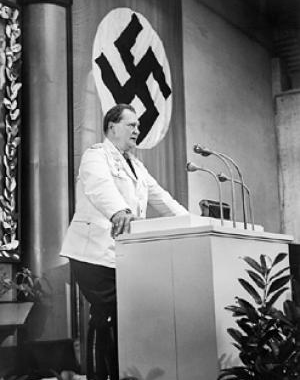
Photo by Hoffmann Heinrich [Public domain], via Wikimedia Commons

Anyone who writes in the Historical Fiction genre must deal with the problem of how to portray real historical characters. Many authors feel free to make up their own interpretations without bothering to dig deeply into factual material. I have never felt that way. When I write about real people, I go to great lengths to illuminate the actual character of the subject based on exhaustive research. The most frequently portrayed real person in my novel, Fall Eagle One, is Hermann Göring, the World War II head of the German Luftwaffe.

The stereotype of Göring in popular consciousness is that of a fat, bumbling buffoon, reinforced by such motion pictures as The Battle of Britain. I could have adopted this caricature without fear of criticism and built my story around it. But I decided to check the facts first. I started by reading two biographies of the Reich Marshal and then branched off to scanning books about other Luftwaffe luminaries. What I discovered was a much more complex character than the popular stereotype.

Göring spoke of himself as a Renaissance man, and he was not far off the mark. He would have been quite at home in the court of a 1500s Italian prince. He was cunning and possessed a near genius IQ. Considering his World War I record, his courage can hardly be questioned. A skilled deer stalker, he wrote the German game statutes that remain in effect to this day. He also opposed vivisection and wrote his beliefs into law. But he did not have the same concerns for other human beings he considered “inferior races.” He presided over bloody purges in the Nazi party and hated Jews as avidly as did Hitler. The man appeared to be totally amoral. Like Hitler, he considered conscience a “Jewish concept” that had no validity. Perhaps his greatest sin was that he made the Nazi Party respectable at a time when many Germans considered them nothing but thugs.

Göring was also avaricious and somewhat lazy. He looted art treasures from all over Europe (he was in Paris buying paintings when the disastrous decision to supply Stalingrad by air was made by his subordinates). He tended to sign documents without reading their contents. One biographer relates how he authorized the Holocaust without troubling himself to read what the order contained.

Göring became addicted to morphine while recovering from a gunshot wound to the groin, which he received during the Munich Putsch. He never completely recovered. While he wore makeup and occasionally practiced cross-dressing, he appears to have been heterosexual. He engaged in numerous affairs and lived openly with both his wives while they were still married to other men.

Like Hitler, Göring may be considered evil incarnate. I believed my readers deserved an accurate portrait of his Machiavellian totality.

Note: My current novel, Fall Eagle One, a novel of World War II, is currently available for Kindle or in paperback from Amazon.com.